
Learn
How Fast Does Mold Grow After Water Damage in Tempe?
Mold can start colonizing wet drywall, carpet, and framing within 24-48 hours — what actually drives that timeline in Tempe's heat, and what slows it down.
Mold can begin colonizing water-damaged material in as little as 24-48 hours under normal conditions. Arizona's heat doesn't slow that clock down the way people assume — trapped humidity behind wet drywall or under padding can accelerate it. The only real defense is starting extraction and drying the same day water shows up, not later that week.
Published 2026-08-15 · Updated 2026-08-30
Water Damage Tempe is a water damage restoration company serving Tempe, AZ and the Phoenix metro, and the 24-48 hour mold window is the single fact that shapes how fast we move on every call.
The 24-48 hour window, and why it’s not a scare tactic
Mold spores are already present in virtually every home — they’re airborne, always. What they need to actually colonize a surface is moisture, and wet organic material (drywall paper, wood framing, carpet backing) gives them exactly that. Independent sources across the restoration and public-health industry converge on the same figure: mold can begin visible or measurable colonization within 24-48 hours of a material getting wet and staying wet. That’s not a sales number — it’s the same timeline cited in restoration-industry standards and by two of the three competitors reviewed for this market in their own FAQ copy. The clock starts the moment water intrudes, not when someone notices it.
Arizona heat: does it help or hurt?
There’s a common assumption that Arizona’s desert climate somehow protects against mold, and it’s only half true. Outdoor humidity in Tempe is genuinely low most of the year, which does slow mold growth on exposed, ventilated surfaces. But water damage rarely stays exposed and ventilated — it’s usually trapped behind drywall, under carpet pad, or inside a wall cavity where a house’s own air conditioning creates a closed, humid pocket that outdoor dryness never touches. A sealed, climate-controlled Tempe home with a wet wall cavity can hold that trapped moisture just as long as a humid-climate house would, sometimes longer, because there’s less natural air exchange working against it.
What actually speeds mold growth in a wet home
A handful of factors push a wet home toward the fast end of that 24-48 hour range rather than the slow end: warmer ambient temperature (mold grows fastest between about 77-86°F, which describes most Tempe interiors for much of the year), organic material like drywall paper or wood subfloor left wet and undisturbed, poor air circulation in the affected area, and — critically — how long the water sat before anyone started extraction. A slab leak that’s been slowly wetting a wall cavity for weeks before it surfaces (see our guide on signs of a slab leak) has already given mold far more than 48 hours by the time anyone calls.
Signs mold has already started
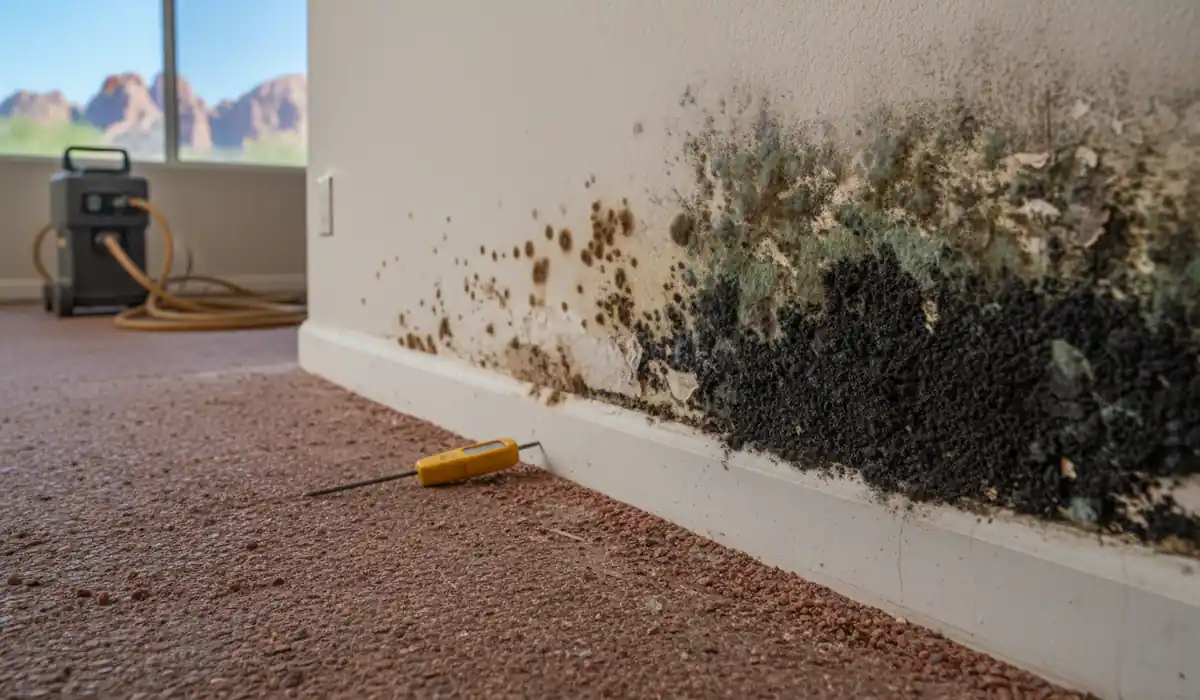
Before visible growth appears, a musty or earthy odor is usually the first tell — that smell means active mold metabolism is already happening somewhere, even if you can’t see it yet. After that, look for discoloration on drywall or baseboards (often a dark gray, black, or greenish tint that wasn’t there before), a fuzzy or slightly raised texture on a wet surface, or a return of the musty smell after a room seemed to dry out. Any of these on a surface that got wet more than two days ago should be treated as active mold, not “maybe.”
What stops the clock
The only thing that actually resets the 24-48 hour countdown is getting standing water out and the affected materials properly dried before mold has the conditions it needs — not just surface-dry, but dry all the way through drywall, subfloor, and framing, which is what professional moisture meters and structural drying equipment are built to verify. That’s the entire logic behind treating water extraction as an emergency-response service rather than a scheduled appointment: every hour between the water hitting the floor and equipment going in is an hour closer to the point where cleanup and drying stop being enough and mold remediation becomes its own separate job.
The bottom line on timing
If water hit your floor, wall, or ceiling in the last 24 hours, the fastest path to avoiding a mold problem is getting extraction started today — not after you’ve called your insurance company, not after you’ve tried a shop vac for a few hours. Call (480) 531-6541 and we’ll walk you through what to do while help is on the way.
Related reading
The bottom line
If you want this priced for your own property rather than in ranges, we come out and assess at no charge across Tempe and the Phoenix metro — including Mesa, Chandler, Scottsdale, Gilbert, and Phoenix. You get a written scope with the water category and affected areas broken out separately. Call (480) 531-6541.