
Decision Guide
Mold Remediation vs. Mold Removal — Is There a Real Difference?
The terms get used interchangeably in marketing, but 'remediation' and 'removal' describe genuinely different scopes of work — here's what each actually includes.
Mold removal usually refers narrowly to physically taking mold off a surface. Mold remediation is the broader, correct term for the full process — containment, removal, addressing the moisture source that caused it, and verification the area is safe — because mold that isn't removed at its moisture source typically returns.
Published 2026-08-15 · Updated 2026-08-30
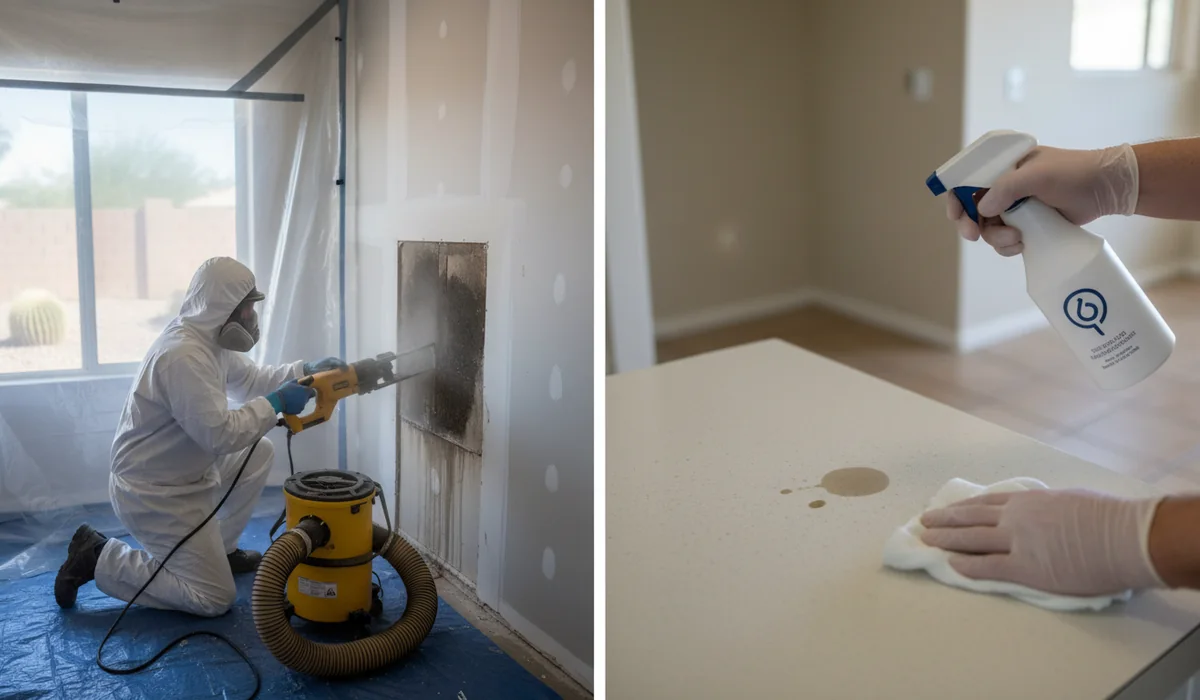
Water Damage Tempe is a water damage restoration company serving Tempe, AZ and the Phoenix metro, and this is one of the most misunderstood pairs of terms in the whole industry — the words get used interchangeably in a lot of marketing copy, but they describe genuinely different scopes of work.
What “mold removal” actually means
Taken literally, mold removal describes the physical act of taking mold off a surface — scrubbing, scraping, or otherwise eliminating visible growth from wherever it’s found. It’s a narrower term, and it’s not wrong exactly, but it describes only one step of a larger process. Removal alone, done without anything else, addresses what’s visible right now without addressing why it’s there.
What “mold remediation” actually means
Remediation is the industry-correct term for the full process, and it includes several steps removal alone doesn’t cover: containment (sealing off the affected area so disturbed mold spores don’t spread to unaffected parts of the house during the work), actual removal of contaminated material, addressing the underlying moisture source that let the mold grow in the first place, and post-work verification that the area is genuinely safe — sometimes including air quality testing. Remediation treats mold as a symptom of a moisture problem, not an isolated surface issue to be wiped away.
Why the distinction actually matters, not just semantically
This isn’t a technicality — it changes the outcome. Mold needs an ongoing moisture source to keep growing. If a company (or a homeowner) removes visible mold from a wall but never identifies or fixes the leak, condensation issue, or ventilation problem that caused it, the mold typically returns, often inside the same wall cavity, sometimes worse than before because the underlying moisture source was never addressed. Remediation without addressing the moisture source isn’t really remediation — it’s removal with a delay before the same problem reappears.
How this connects to the water damage that usually causes it
Mold in a Tempe home is very rarely a standalone problem — it’s almost always downstream of a water intrusion event: a slab leak that ran for weeks before discovery (see our signs of a slab leak guide), a water heater failure, or standing water that wasn’t extracted and dried within the 24-48 hour window before it colonized. This is why remediation and water damage restoration are so closely linked in practice: properly stopping and drying the original water event is often the single most effective form of mold prevention, and remediation after the fact is what happens when that window was missed.
What proper remediation looks like, step by step
Assessment first — identifying the extent of the growth and, critically, the moisture source driving it. Containment second — sealing the work area to prevent spore spread. Removal of affected material third — porous materials that have been colonized (drywall, insulation, sometimes carpet) typically need to be physically removed rather than just cleaned, since mold can grow into the material itself, not just on its surface. Then addressing the moisture source directly, whether that means completing structural drying that was left unfinished or coordinating a plumbing repair for a slab leak. Finally, verification — confirming the area reads dry and clear before it’s considered done.
The licensing landscape in Arizona
Arizona doesn’t have a dedicated statewide mold-remediation license the way some states do — mold work involving construction or repair is governed under the state’s general Registrar of Contractors (ROC) rules, along with general OSHA workplace-safety obligations. IICRC certification is the widely-recognized voluntary industry credential companies pursue to demonstrate they follow the standard remediation protocol, though it isn’t a state licensing requirement.
The bottom line
“Removal” and “remediation” aren’t interchangeable — one addresses what’s visible, the other addresses why it’s there. If you’re dealing with mold, the question worth asking any company (including us) is whether the moisture source is part of the plan, not just the visible growth. Call (480) 531-6541 for a free on-site assessment that starts with exactly that question.
Related reading
The bottom line
If you want this priced for your own property rather than in ranges, we come out and assess at no charge across Tempe and the Phoenix metro — including Mesa, Chandler, Scottsdale, Gilbert, and Phoenix. You get a written scope with the water category and affected areas broken out separately. Call (480) 531-6541.