
Learn
What Are the Water Damage Categories, and Why Does It Matter?
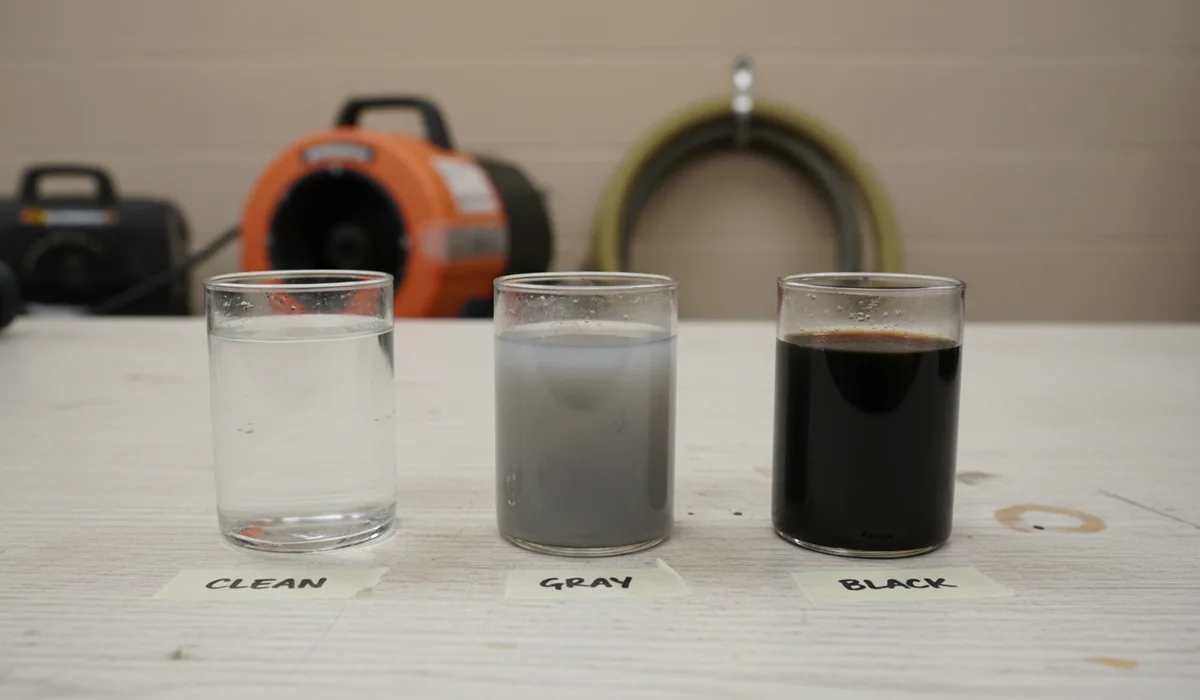
The IICRC S500 standard splits water damage into three categories — clean, gray, and black — and the category determines what's safe to touch and how the job gets priced.
The IICRC S500 standard defines three water categories: Category 1 (clean, from a supply line), Category 2 (gray, from an appliance or sink overflow), and Category 3 (black, from sewage or flooding). The category determines what protective steps are required, what can be saved versus what must be discarded, and the cost — Category 3 runs roughly double Category 1 per square foot.
Published 2026-08-15 · Updated 2026-08-30
Water Damage Tempe is a water damage restoration company serving Tempe, AZ and the Phoenix metro, and identifying the water category is the first thing our crew does on every job — before extraction, before anything else — because it determines almost every decision that follows.
Category 1: clean water
Category 1 water comes from a sanitary source — a broken supply line, a water heater failure, an overflowing sink with no soap or waste in it, or rainwater intrusion before it touches ground contaminants. It poses no meaningful health risk on contact. This is the category most burst-pipe and slab-leak calls start as, and it’s also the fastest and least expensive to remediate: pricing across sources for Category 1 work runs roughly $3-$4 per square foot. The catch is that Category 1 water doesn’t stay Category 1 forever — left sitting, particularly in a warm, humid wall cavity, it can begin degrading toward Category 2 within about 48 hours.
Category 2: gray water
Category 2 (gray water) carries a measurable level of contamination — think a washing machine or dishwasher overflow, an aquarium leak, or a toilet overflow with urine but no feces. It can cause illness if ingested or if it contacts broken skin, which changes the handling protocol: more protective equipment, more careful disposal of porous materials that absorbed it, and no “just towel it up yourself” approach. Gray water sits between Category 1 and 3 on price too, though it doesn’t have a single widely-published per-square-foot figure the way the other two categories do — pricing runs off the same square-footage and job-size factors as any restoration job, adjusted for the extra handling steps.
Category 3: black water
Category 3 is grossly contaminated water — sewage backups, flooding that’s picked up ground contaminants, or any water that’s been standing long enough to support significant bacterial and fungal growth. This is a genuine biohazard: it should never be handled without protective equipment, and it typically means more material gets discarded rather than dried, since porous surfaces (carpet, drywall, insulation) that absorb black water usually can’t be safely saved. That extra disposal, containment, and protective-equipment burden is why Category 3 work runs roughly $7-$7.50 per square foot — close to double Category 1’s rate. See our sewage backup guide for exactly what not to touch yourself if this is your situation.
Why the category changes what happens next
The category isn’t just a label — it’s the decision point for nearly everything downstream. It determines what personal protective equipment the crew wears, whether a material gets dried in place or pulled out and discarded, how the job is priced, and how much containment is needed to keep contamination from spreading to unaffected rooms. This is also why an accurate on-the-spot category assessment matters more than a quick guess: misclassifying Category 2 water as Category 1 means under-protecting the crew and potentially leaving contamination behind; over-classifying clean water as gray or black means unnecessary cost and unnecessary material loss.
How the category interacts with time
Every category gets worse the longer water sits, but Category 1 has the most ground to lose — a clean supply-line leak caught within hours stays cheap and simple, while the same leak left three days risks reclassifying toward Category 2 territory as bacterial growth sets in, on top of the mold-colonization risk covered in our 24-48 hour mold guide. Speed doesn’t just limit square footage — it limits which category you’re actually dealing with by the time help arrives.
The bottom line
Knowing your water’s category isn’t something you need to diagnose yourself — it’s the first thing we determine on a free on-site assessment, and it’s what our written scope is actually built around. A written scope that names the category up front also gives you something concrete to compare against if you get a second opinion or need to explain the job to an adjuster — it’s a lot harder to dispute “Category 1, extracted within four hours, X square feet affected” than a vague verbal estimate. Call (480) 531-6541 day or night and we’ll tell you exactly what you’re dealing with before any work starts.
Related reading
The bottom line
If you want this priced for your own property rather than in ranges, we come out and assess at no charge across Tempe and the Phoenix metro — including Mesa, Chandler, Scottsdale, Gilbert, and Phoenix. You get a written scope with the water category and affected areas broken out separately. Call (480) 531-6541.