
Learn
Why Is Sewage Backup a Biohazard, and What Shouldn't I Do Myself?
Sewage backup is Category 3 black water — a genuine health hazard, not a bigger version of a normal spill. Here's what to avoid touching and why.
Sewage backup is Category 3 (black) water — grossly contaminated with bacteria, viruses, and waste that can cause real illness on contact. Don't touch it without protective equipment, don't run a shop vac through it, and don't try to save carpet or drywall it soaked into. Ventilate the area, keep people and pets out, and call for professional cleanup.
Published 2026-08-15 · Updated 2026-08-30
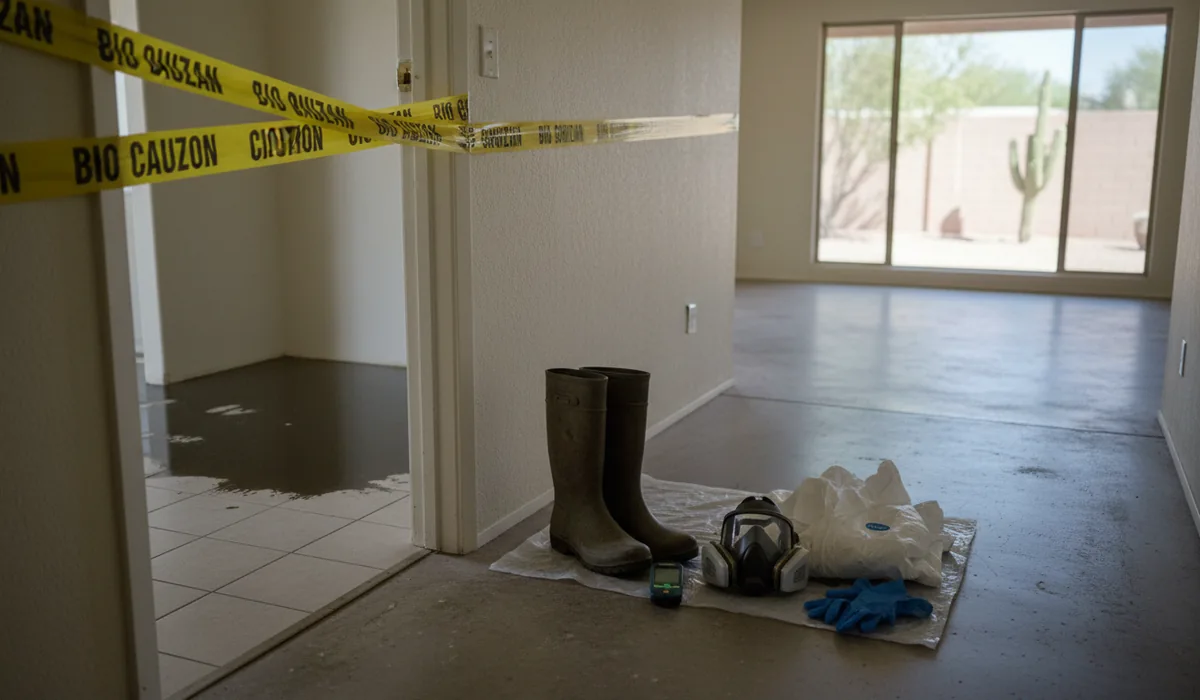
Water Damage Tempe is a water damage restoration company serving Tempe, AZ and the Phoenix metro, and sewage backup calls get the fastest possible response in our dispatch order — this is the one water damage scenario where the health risk is immediate, not just a property concern.
Why sewage backup is different from every other kind of water damage
Under the IICRC S500 standard, sewage backup is Category 3 — grossly contaminated water that can carry bacteria, viruses, parasites, and other pathogens capable of causing real illness on contact, through inhalation of aerosolized particles, or through contact with broken skin. This isn’t a matter of degree compared to a clean supply-line leak — it’s a categorically different hazard that requires different handling from the first minute, covered in more detail in our water damage categories guide.
What not to do — the specific mistakes that make it worse
Don’t touch it without protective equipment. Gloves, boots, and eye protection are the minimum — bare-handed contact with sewage-contaminated water is a real exposure risk, not an overreaction.
Don’t run a household shop vac or wet vac through it. A shop vac isn’t built to contain or filter contaminated water safely, and running one through black water risks aerosolizing contaminated particles into the air you’re breathing, spreading contamination well beyond the original spill area.
Don’t try to save porous materials it soaked into. Carpet, carpet padding, drywall, insulation, and upholstered furniture that absorbed Category 3 water typically can’t be safely disinfected — the contamination gets into the material itself, not just the surface. Treating it as salvageable and drying it in place, rather than removing it, is one of the most common and most costly DIY mistakes.
Don’t let kids or pets anywhere near the affected area, including adjacent rooms if the smell has spread. Keep the area closed off until it’s been professionally assessed.
Don’t assume bleach solves it. Surface disinfection doesn’t reach what’s soaked into subfloor or wall cavities, and it can create a false sense that an area is safe when contamination remains underneath.
What you should do while waiting for help
Ventilate the area if you can do so without wading through the water — open windows, run exhaust fans, anything that moves contaminated air out without spreading it further. Shut off the water source if it’s a backup you can identify and stop (a clogged main line backing up through a floor drain, for example). Keep everyone, including pets, out of the affected area and any room the smell has reached. Then call (480) 531-6541 — this is not a situation to wait out or handle with household cleaning supplies.
Why speed still matters even though this isn’t a DIY job
Category 3 water causes damage on two timelines at once: the immediate contamination risk, and the same mold-colonization clock that applies to every water intrusion — mold can begin colonizing material within 24-48 hours, and Category 3 water sitting that long compounds both problems simultaneously. The fact that you shouldn’t touch it yourself doesn’t mean it’s safe to wait — it means the professional response needs to start immediately instead.
What happens during professional sewage cleanup
A proper response includes containment (sealing off the affected area to prevent contamination spreading to unaffected parts of the house), extraction of the contaminated water, removal and disposal of anything porous that absorbed it, antimicrobial treatment of surfaces that can be saved, and structural drying of what remains — then air quality verification before the space is cleared for normal use again. It’s a fundamentally different process from a clean-water job, not a bigger version of the same one.
The bottom line
Sewage backup is the one call where “wait and see” carries a real health risk on top of the property risk. If you’re dealing with a backup right now, don’t touch it — call (480) 531-6541 for immediate help, day or night.
Related reading
The bottom line
If you want this priced for your own property rather than in ranges, we come out and assess at no charge across Tempe and the Phoenix metro — including Mesa, Chandler, Scottsdale, Gilbert, and Phoenix. You get a written scope with the water category and affected areas broken out separately. Call (480) 531-6541.