
Learn
What Actually Happens During Professional Water Extraction?
A walkthrough of what professional water extraction involves in Tempe, from the first call through moisture mapping and the handoff to structural drying.
Professional water extraction identifies the water category, removes standing water with truck-mount or portable equipment, then maps moisture with meters across floors, subfloor, and walls to find water that migrated out of sight. It ends with a handoff straight into structural drying — the two phases run back to back, not as separate scheduled jobs.
Published 2026-08-15 · Updated 2026-08-30
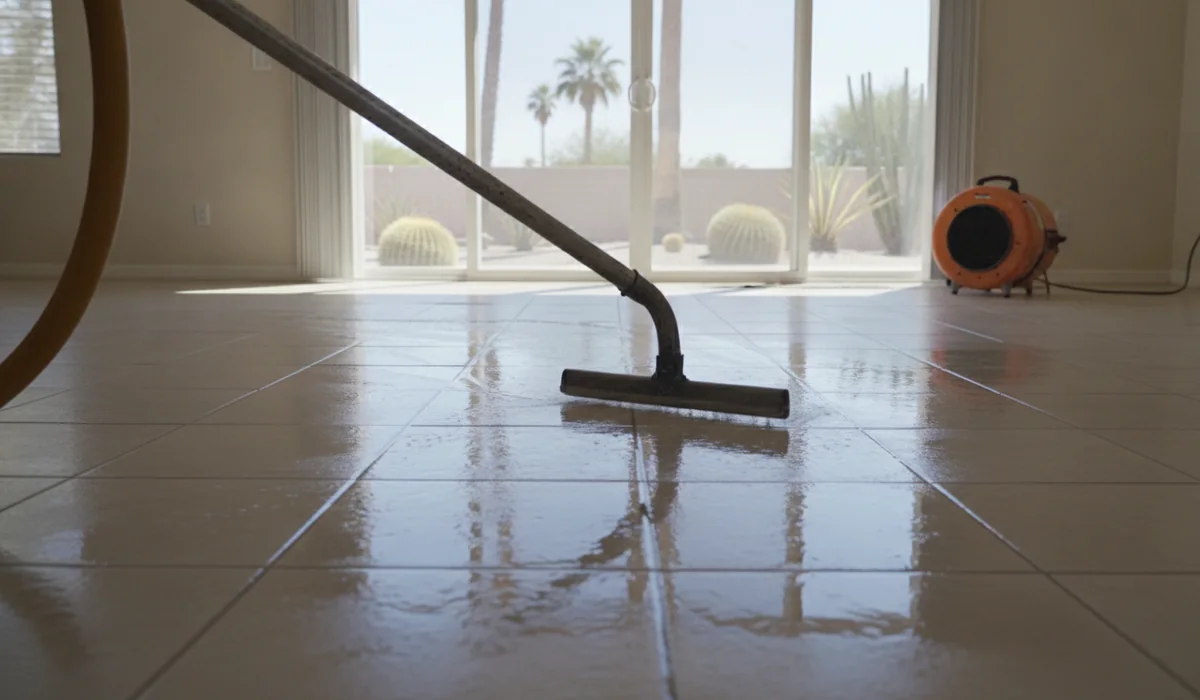
Water Damage Tempe is a water damage restoration company serving Tempe, AZ and the Phoenix metro, and this is the exact sequence our crew runs on a water extraction job, start to finish.
Step 1: Call and describe the situation
The process starts with a phone call, not a scheduled appointment — a real person answers day or night and books a free on-site assessment. Telling us what happened (burst pipe, appliance failure, slab leak, storm intrusion) helps the crew arrive with the right equipment already loaded, rather than figuring it out on-site.
Step 2: Identify the water category before anything else
Before extraction starts, we determine whether it’s Category 1 (clean), 2 (gray), or 3 (black) water, since that classification determines the safety protocol, what protective equipment the crew uses, and what can be dried in place versus what has to be discarded. See our full breakdown in water damage categories explained — this step isn’t skippable, since getting it wrong means either under-protecting the crew or unnecessarily discarding salvageable material.
Step 3: Remove standing water
This is the extraction itself — truck-mount extraction units (the highest-capacity option, powered from a vehicle parked outside) or portable extraction equipment for tighter spaces, upper floors, or smaller jobs where a truck-mount isn’t practical. Standing water gets pulled out of the space as quickly as the job allows, since every additional hour of standing water raises both the total damaged square footage and the risk that a Category 1 job starts degrading toward Category 2.
Step 4: Map the moisture — the step that gets skipped in DIY cleanup
This is the part that separates professional extraction from a shop vac and some towels. Moisture meters get run across floors, subfloor, and walls — not just the visibly wet area — to trace where water actually migrated. Water rarely stays contained to where it first appears; it wicks under baseboards, travels along subfloor seams, and can climb several feet up inside a wall cavity through capillary action. Baseboards get pulled and weep holes drilled where needed so water trapped inside wall cavities has somewhere to escape rather than sitting hidden until it causes a mold problem weeks later. Time-stamped photos and moisture logs get taken throughout — useful for your own records and, if you’re filing a claim, for an insurance adjuster.
Step 5: Assess what can be dried in place vs. what needs to come out
Carpet and pad get evaluated individually. Clean water caught within a few hours can often be dried in place with the carpet and pad intact. Water that sat longer, or anything above Category 1, usually means the pad — and sometimes the carpet — needs to come out, since saturated padding rarely dries fully in place and traps moisture against the subfloor even after the surface looks dry.
Step 6: Hand off directly into structural drying
Once the bulk water is out and moisture is mapped, drying equipment goes in immediately — air movers and dehumidifiers positioned based on the moisture map from Step 4, not a generic setup. Extraction and drying are sequential phases of the same job, not two separate services scheduled independently; see our structural drying timeline guide for what happens next and how long it typically takes.
Why this differs from what most people try themselves
A shop vac and box fans can remove visible standing water, but they don’t map hidden moisture, don’t reach inside wall cavities, and don’t produce documentation an insurance adjuster can use. Our full comparison in DIY vs. professional water extraction covers exactly where the line is between a job that’s genuinely fine to handle yourself and one where skipping professional extraction costs more later than it saves now.
The bottom line
Extraction is the fastest-moving phase of a water damage job, but it’s also the phase where mistakes — missed moisture, materials dried that should have been discarded, or a category misjudged — cause problems that surface weeks later. Call (480) 531-6541 for a free on-site assessment and we’ll walk the full process with you before any work starts.
Related reading
The bottom line
If you want this priced for your own property rather than in ranges, we come out and assess at no charge across Tempe and the Phoenix metro — including Mesa, Chandler, Scottsdale, Gilbert, and Phoenix. You get a written scope with the water category and affected areas broken out separately. Call (480) 531-6541.