
Decision Guide
DIY Water Cleanup vs. Professional Extraction — When Is DIY Actually Enough?
A shop vac and fans work for a genuinely small spill. Here's the honest line between when DIY water cleanup is fine and when it costs more than it saves.
DIY is genuinely fine for a small, contained Category 1 spill caught within an hour or two, with no carpet padding or wall cavities involved. Once water sits longer, reaches under flooring or inside walls, or is anything other than clean, professional extraction with moisture mapping becomes the safer and, in the long run, cheaper option.
Published 2026-08-15 · Updated 2026-08-30
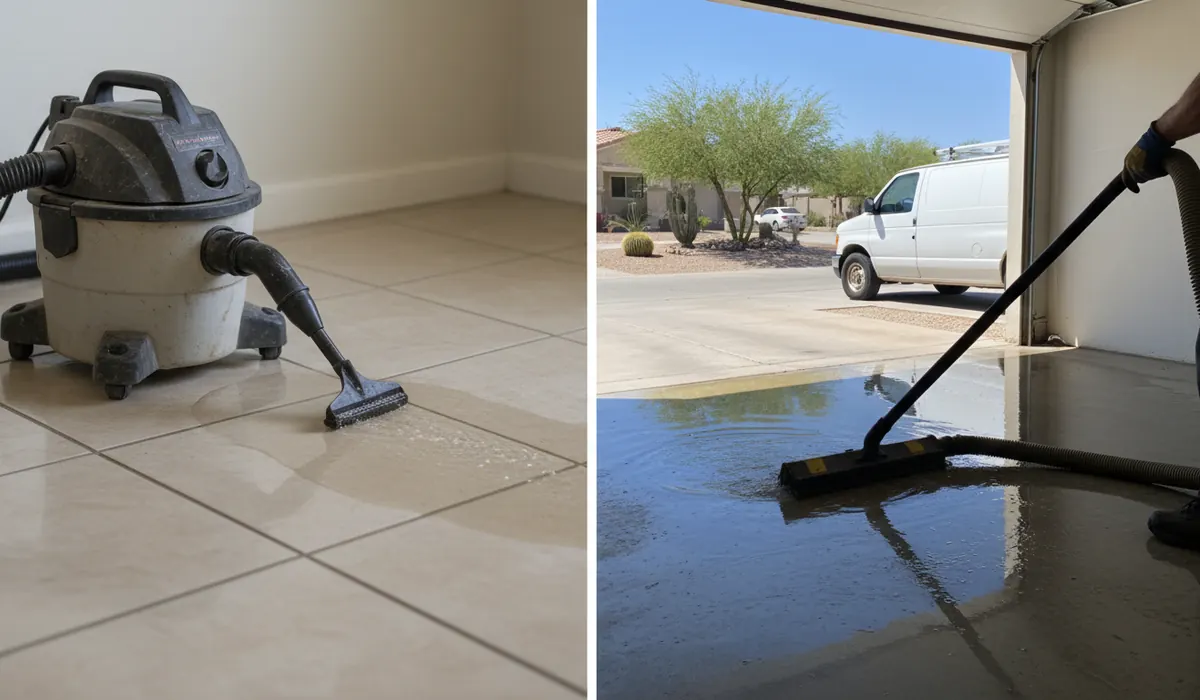
Water Damage Tempe is a water damage restoration company serving Tempe, AZ and the Phoenix metro, and we’d rather give you an honest answer about when DIY is genuinely fine than push a service call you don’t need — this guide is that honest answer.
When DIY is actually enough
A small, clean-water spill — a supply line under a sink, a toilet supply valve, a small appliance overflow — caught within an hour or two, on a hard, non-porous surface like tile or sealed concrete, with no carpet or subfloor involved, is a completely reasonable DIY job. Mop it up, run fans to finish evaporating the surface moisture, and check back the next day to confirm there’s no lingering dampness or smell. This is genuinely the category most small household spills fall into, and there’s no reason to call anyone for it.
Where the line actually is
The line isn’t about how much water there was — it’s about whether the water had time or a path to get somewhere a shop vac and fans can’t reach. Three questions determine which side of the line you’re on:
Did the water sit for more than a couple of hours? Beyond that window, water starts wicking into porous materials — carpet pad, subfloor, drywall — in ways a wet-dry vac’s surface pass doesn’t fully address.
Did the water reach carpet, carpet padding, or flooring with a seam or gap it could migrate under? Water travels sideways under flooring far more than most people expect, and a shop vac only removes what’s visible on the surface, not what’s already migrated a few feet away under the material.
Is there any chance it reached a wall cavity — through baseboards, an electrical outlet, or a gap where flooring meets a wall? This is the scenario DIY cleanup misses most often, because there’s no visible sign at all once the surface dries, yet a wet wall cavity is exactly the environment where the 24-48 hour mold-colonization window (see our mold-growth guide) does its damage.
What professional extraction adds that DIY genuinely can’t
The real difference isn’t extraction power — it’s moisture mapping. A professional crew runs meters across floors, subfloor, and walls to trace where water actually migrated, not just where it’s visible, covered step by step in our water extraction process guide. That’s the step a shop vac and fans structurally cannot replicate, because it requires instruments that measure moisture inside materials, not just what’s visible on top of them. It’s also the step that prevents the scenario where a DIY cleanup looks finished, feels dry, and then produces a musty smell and a drywall repair three weeks later.
The real cost comparison
The comparison people run in their head is usually “what does professional extraction cost” versus “what does DIY cost” (near zero). That’s the wrong comparison. The real one is “what does catching it correctly the first time cost” versus “what does a missed pocket of moisture that becomes a mold problem cost” — and mold remediation, once needed, is priced as a separate line item on top of whatever the original water damage would have cost to address correctly. A free on-site assessment doesn’t cost anything to find out which situation you’re actually in.
A reasonable middle ground
If you’re not sure which side of the line you’re on, DIY the immediate cleanup — get the visible water up, run fans — and then call for a free assessment to confirm there’s nothing hidden. That’s a completely reasonable approach: it doesn’t waste the time-sensitivity of getting water off the floor while still getting a professional check before assuming the job is actually done.
The bottom line
DIY is the right call for small, fast, clean-water spills on hard surfaces. Anything with time, porous material, or an unknown path involved is worth a free assessment before you assume it’s handled. Call (480) 531-6541 and we’ll tell you honestly which situation you’re in.
Related reading
The bottom line
If you want this priced for your own property rather than in ranges, we come out and assess at no charge across Tempe and the Phoenix metro — including Mesa, Chandler, Scottsdale, Gilbert, and Phoenix. You get a written scope with the water category and affected areas broken out separately. Call (480) 531-6541.