
Learn
What Should I Photograph Before an Insurance Adjuster Inspects Water Damage?
The exact documentation — photos and moisture readings — that supports a water damage insurance claim, and why it has to happen before drying starts.
Time-stamped photos and moisture readings of every affected area, taken before anything gets removed or dried, plus photos of the source itself and any damaged items. Water Damage Tempe hands over a full moisture log with every job specifically so that documentation exists before the adjuster ever shows up.
Published 2026-08-20 · Updated 2026-09-01
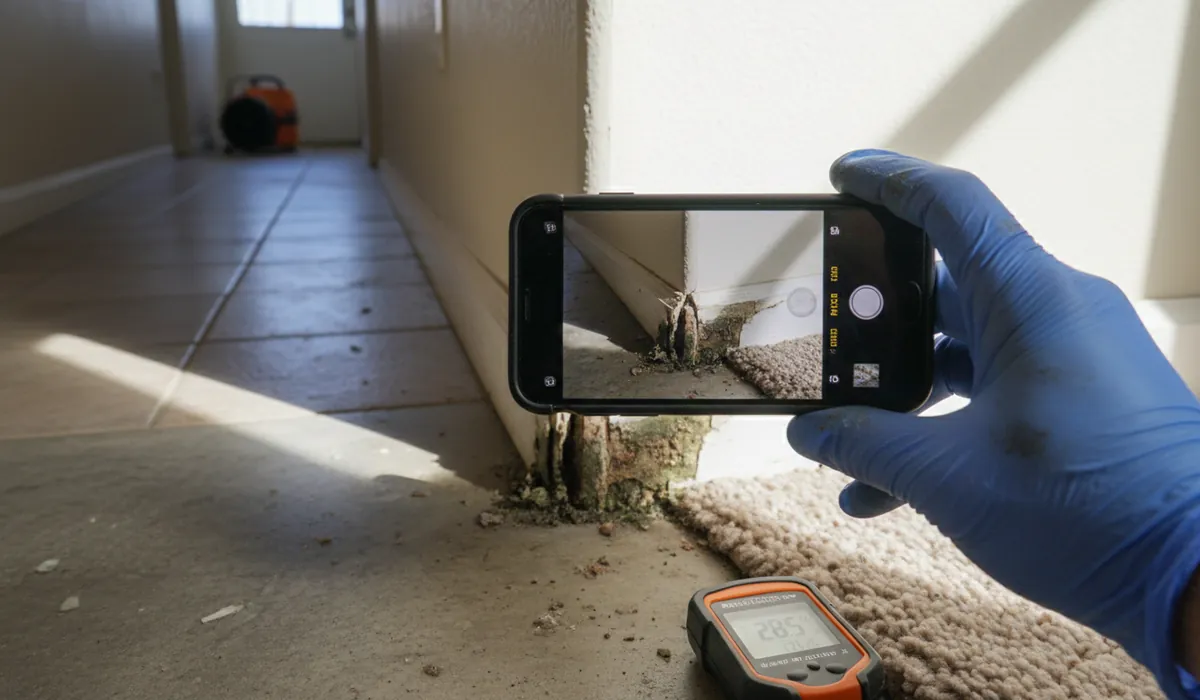
Water Damage Tempe is a water damage restoration company serving Tempe, AZ and the Phoenix metro, and documentation is the single most controllable factor in how smoothly a water damage insurance claim goes — more controllable than the cause of the damage itself.
Photograph the source first
Before anything else, photograph whatever caused the water — the burst pipe, the failed water heater, the roof breach, the visible slab-leak indicator. This establishes what happened and, where possible, when it likely started. If the source has already been shut off or stopped, photograph it in that state too, since an adjuster needs to see the mechanism of failure, not just its aftermath.
Photograph every affected area before drying starts
Once the source is documented, photograph every room and surface the water reached — flooring, walls, baseboards, ceilings, and any furniture or belongings in the affected footprint. These photos need to happen before extraction and drying begin, because once water is removed and equipment goes in, the scene an adjuster would have inspected no longer exists. Time-stamps matter here: a phone’s default photo metadata is usually sufficient, but noting the date and time in writing as a backup is worth the extra minute.
Keep a moisture log, not just photos
Photos show what’s visibly wet; a moisture log shows what’s wet that you can’t see — inside wall cavities, under flooring, in subfloor. Water Damage Tempe’s own on-site assessments take and log moisture readings across floors, subfloor, and walls before extraction begins, specifically so that hidden water migration is documented rather than discovered later without a paper trail. That log becomes part of the claim file alongside the photos.
Don’t discard damaged items before they’re documented
It’s tempting to start pulling out ruined carpet or waterlogged furniture immediately, especially with active water damage. Photograph everything in place first, including a close-up of any damage detail (staining, warping, delamination) that shows the extent clearly. Once something is documented, removing it to prevent mold or further damage is reasonable and expected — the goal is sequencing, not delay.
A simple documentation checklist
In order, before extraction or drying begins: photograph the source of the water; photograph every affected room from multiple angles, including close-ups of visible damage; photograph any damaged belongings in place before moving them; note the approximate date and time you first noticed the water, and how it was discovered; keep any receipts for damaged items you can locate; and request a written moisture log if a restoration company is on-site taking readings. None of these steps require special equipment — a phone camera and a notes app cover all of them.
What this documentation actually changes in a claim
Good documentation is what lets an adjuster make the sudden-vs-gradual determination in your favor when the facts genuinely support it, and it’s what identifies the water category (clean, gray, or black) that affects both the claim and the remediation scope. Without it, a claim relies on a homeowner’s account after the fact, which carries far less weight than a time-stamped photo taken before anything changed.
When documentation happens too late to help
If extraction already started before anything was photographed — a common situation when water is actively spreading and speed matters more than paperwork — document what remains: current moisture readings, remaining visible damage, and a written account of what was removed and when. It’s a weaker record than pre-drying photos, but an adjuster still has something concrete to evaluate rather than nothing at all, and a restoration company’s own job notes and moisture logs from that point forward still carry real weight.
Related questions
The bottom line
If you want this priced for your own property rather than in ranges, we come out and assess at no charge across Tempe and the Phoenix metro — including Mesa, Chandler, Scottsdale, Gilbert, and Phoenix. You get a written scope with the water category and affected areas broken out separately. Call (480) 531-6541.