
Learn
Does Insurance Cover a Slab Leak in Arizona?
Why a slab leak claim splits into two separate coverage questions — the plumbing repair and the resulting water damage — and what actually helps it get approved.
Sometimes, and it depends which half of the bill you mean. The plumbing repair itself — locating and fixing the pipe — is typically treated as normal wear and excluded. The resulting water damage above the slab is more often covered, but only if it can be shown to be sudden rather than a slow, undetected drip.
Published 2026-08-20 · Updated 2026-09-01
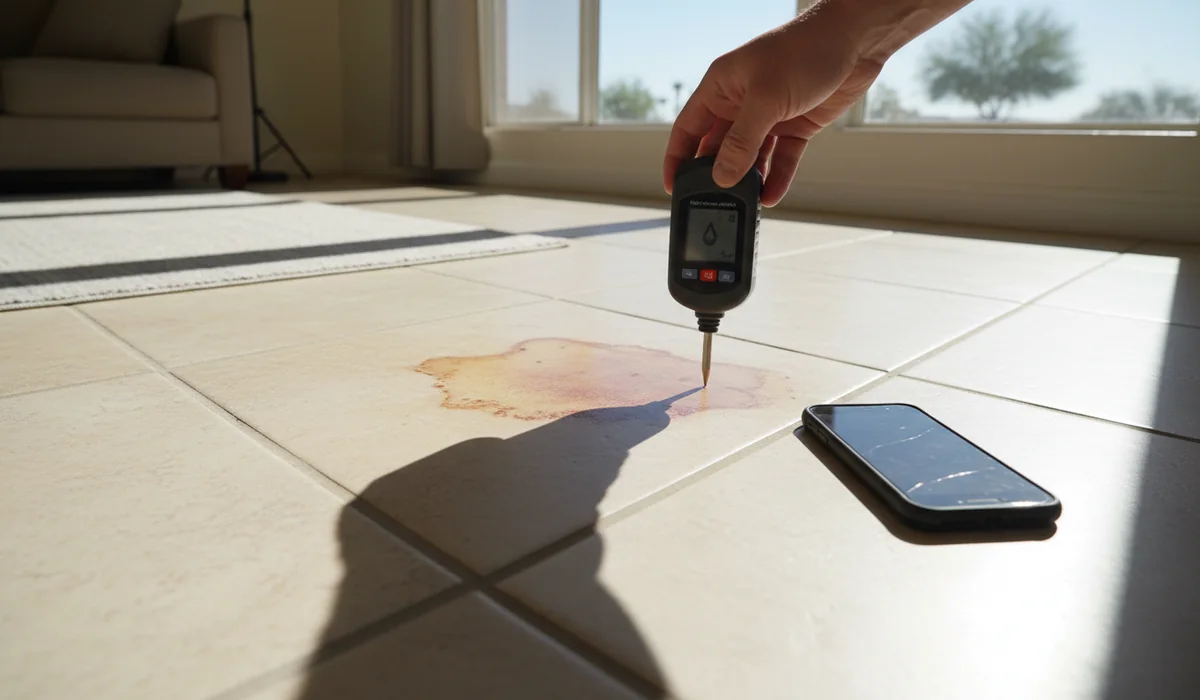
Water Damage Tempe is a water damage restoration company serving Tempe, AZ and the Phoenix metro, and slab leaks generate more insurance confusion than any other cause of water damage in this market — mostly because the claim actually has two separate halves.
The plumbing repair: usually not covered
Locating and fixing the pipe itself — the plumbing-side repair covered in detail in our slab leak cost guide — is typically treated as normal wear on the home’s systems rather than a covered peril. Insurers generally view aging or corroding pipe as a maintenance responsibility, not a sudden loss, regardless of how the leak was eventually discovered.
The resulting damage: often covered, if it’s sudden
The water damage above the slab — flooring, subfloor, drywall, baseboards — is a separate question, and it’s evaluated on the same sudden-vs-gradual standard as any other water damage claim. If the leak can reasonably be shown to have started shortly before it was found, the restoration side has a real path to coverage even when the plumbing repair itself doesn’t.
Why slab leaks are the hardest sudden-vs-gradual call in this market
Phoenix-area hard water accelerates corrosion of copper supply lines running under the slab, and Arizona’s expansive clay soils shift with seasonal moisture and heat, stressing buried pipe until it fails. Both mechanisms tend to develop gradually before the actual rupture — and because the leak is under the slab, the visible sign (a warm spot on tile, a damp patch of carpet) is often the first moment anyone could have known, even though the underlying corrosion or stress had been building for longer. That gap between “when it became visible” and “when it actually started” is precisely what makes slab leak claims harder to classify than a pipe that bursts in plain sight.
What a denied claim usually has in common
Claims that get denied on a slab leak tend to share a pattern: a homeowner who noticed a small sign — a slightly warm patch of tile, a faint musty smell — weeks or months before calling anyone, or a water bill that had been climbing for a while before the leak was investigated. Both give an adjuster a reasonable basis to argue the underlying condition existed longer than the point of discovery. This isn’t a reason to avoid documenting early warning signs — it’s a reason to act on them immediately once noticed, since delay after the first sign is what actually weakens a claim, not the existence of the sign itself.
What actually helps a slab leak claim get approved
Reporting the moment it’s discovered, rather than waiting to see if it resolves on its own, is the single most useful thing a homeowner can do. A plumber’s diagnostic report on the actual cause of failure, time-stamped photos of the damage before any drying starts, and a written moisture log from the restoration assessment all give an adjuster concrete evidence to evaluate rather than a homeowner’s account after the fact. None of this guarantees an approval — but it removes the ambiguity that gets a genuinely sudden failure mistakenly treated as a long-running one.
If the plumbing repair gets denied but the damage doesn’t
It’s worth understanding that a partial outcome — plumbing repair denied, restoration approved — isn’t unusual and isn’t a sign something went wrong with the claim. Many homeowners plan for the plumbing repair as an out-of-pocket cost from the start precisely because it’s the less likely half to be covered, while treating the restoration side as the part genuinely worth pursuing through insurance. Framing it that way going in tends to make the overall process less frustrating than expecting one unified approval or denial.
Related questions
The bottom line
If you want this priced for your own property rather than in ranges, we come out and assess at no charge across Tempe and the Phoenix metro — including Mesa, Chandler, Scottsdale, Gilbert, and Phoenix. You get a written scope with the water category and affected areas broken out separately. Call (480) 531-6541.