
Cost Guide
What Does a Slab Leak Cost to Fix, Including the Restoration Side?
The two separate bills behind a slab leak — plumbing repair and water damage restoration — broken out with real sourced figures for each.
A slab leak bill has two separate halves: the plumbing repair itself runs $60-$250 per linear foot (full sewer-line replacement $1,500-$20,000+, plus a $100-$250 diagnostic call), and the restoration of everything the leak damaged above the slab prices separately, off the same water-category and square-footage math as any other water damage job.
Published 2026-08-20 · Updated 2026-09-01
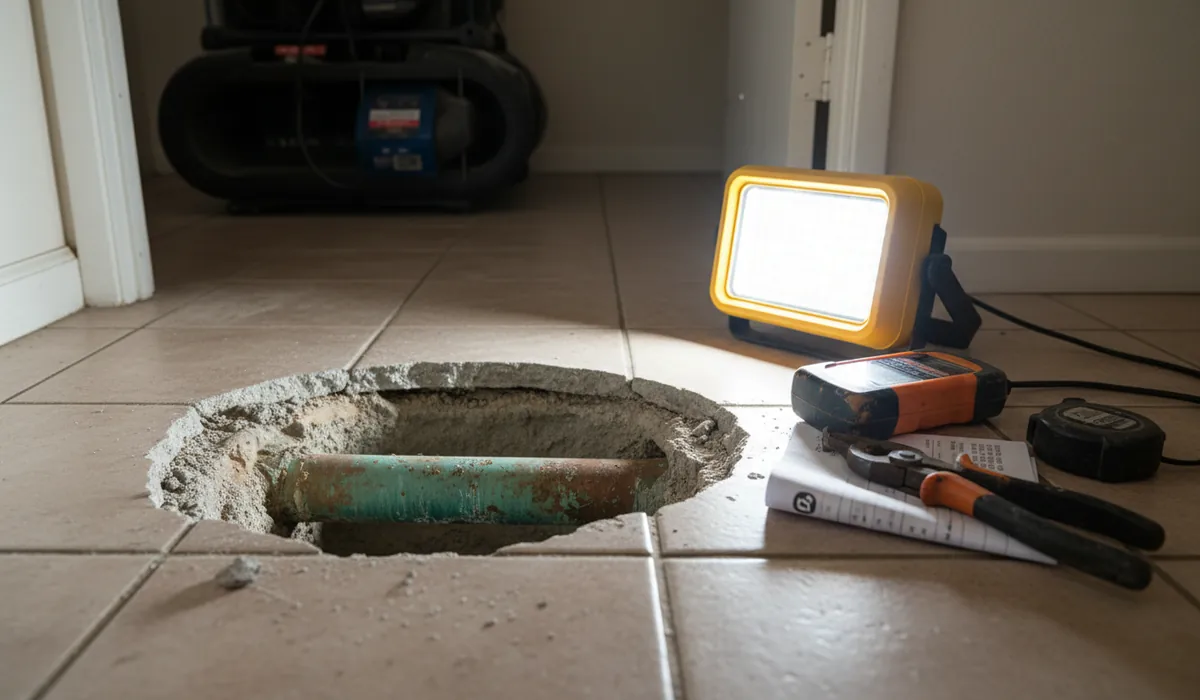
Water Damage Tempe is a water damage restoration company serving Tempe, AZ and the Phoenix metro, and a slab leak is the one water damage cause in this market where homeowners routinely get quoted for only half the job.
The plumbing half: locating and fixing the leak
The pipe repair itself — the plumbing side of a slab leak — runs $60-$250 per linear foot. If the failure requires a full sewer-line repair or replacement rather than a spot fix, that jumps to $1,500-$20,000+ depending on scope. A same-day diagnostic call to locate the leak in the first place typically runs $100-$250 on its own, before any repair work starts. This is a plumber’s bill, calculated independently of anything the water damaged above the slab.
Why caliche soil raises the price here specifically
Phoenix-area caliche — the calcium-carbonate-cemented hardpan layer that also explains why basements are rare in this market — makes excavation harder than in non-caliche regions. When a slab leak repair calls for digging to access the pipe, that caliche layer specifically increases the excavation labor cost compared to what the same repair would run somewhere without it. It’s a genuinely local factor, not a generic “everything’s more expensive here” markup.
The restoration half: what the leak damaged above the slab
Once the plumbing side is handled, the restoration side prices the same way any other water-category job does. A slab leak that’s been running long enough to reach flooring and subfloor is usually Category 1 or 2 water, pricing at $3-$4 per square foot for clean water, scaled to whatever area the water actually reached. This is where the Tempe-specific restoration average of $2,251-$2,313 (Homeyou) and the broader $1,200-$7,600 range across sources become relevant — the slab leak itself is just the cause; the restoration cost follows the same math as a burst pipe or appliance failure once water is loose in the structure.
How a plumber actually finds the leak before pricing the repair
The diagnostic call covered above typically involves electronic leak detection — acoustic listening equipment and sometimes infrared or tracer-gas methods — to pinpoint the leak’s location under the slab without guessing where to dig. Once located, the plumber generally chooses between a spot repair (accessing just the failed section of pipe, either through the slab or by tunneling under it) or a full reroute (running new supply line through the attic or walls instead, bypassing the damaged under-slab section entirely). A reroute often costs more upfront but avoids repeated slab cuts if the same aging copper line is likely to fail again elsewhere — a trade-off the plumber prices out based on the pipe’s age and material.
Why these two bills get confused constantly
Homeowners searching “slab leak cost” often find only the plumbing-side figures, then assume that number covers everything — or the reverse, seeing only a restoration estimate and wondering why the plumber’s invoice arrived separately. Both bills are real and both apply; the confusion comes from most published pricing content covering one trade’s side of the job without mentioning the other exists.
What insurance does and doesn’t cover
The plumbing repair itself is typically treated as normal wear and excluded from a homeowners policy. The resulting water damage above the slab is more often covered, but only if it can be shown to be sudden rather than a slow, undetected leak — a distinction covered in full in the dedicated slab leak insurance guide linked below.
Related questions
The bottom line
If you want this priced for your own property rather than in ranges, we come out and assess at no charge across Tempe and the Phoenix metro — including Mesa, Chandler, Scottsdale, Gilbert, and Phoenix. You get a written scope with the water category and affected areas broken out separately. Call (480) 531-6541.