
Learn
What Is Caliche, and Why Does It Drive Slab Leaks in Arizona Homes?
Caliche hardpan soil and Arizona's expansive clay layers are the two soil mechanisms driving slab leaks here — combined with hard water corroding copper pipe under the slab.
Caliche is a cemented, rock-hard soil layer common across the Phoenix metro; combined with Arizona's expansive clay, which swells and shrinks with moisture and heat, it shifts the ground beneath a home's slab and stresses buried copper pipe until it ruptures. Phoenix-area hard water accelerates that pipe's corrosion at the same time — two mechanisms compounding at once.
Published 2026-08-15 · Updated 2026-08-30
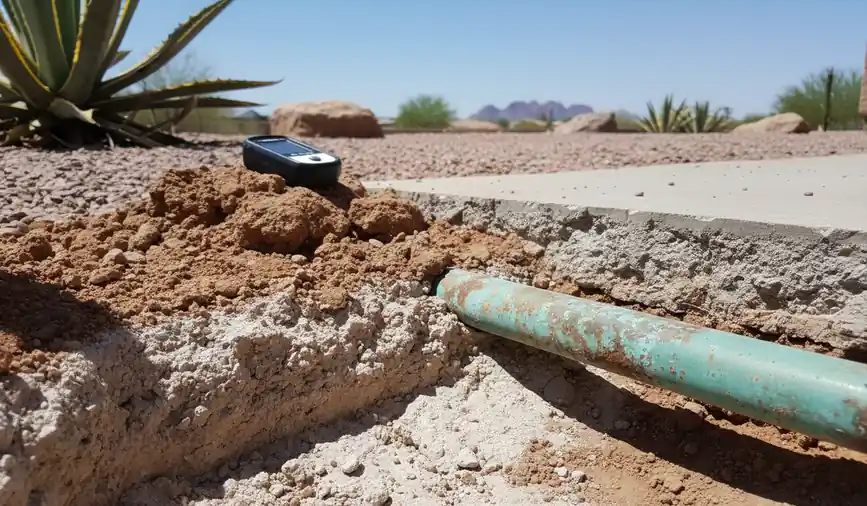
Water Damage Tempe is a water damage restoration company serving Tempe, AZ and the Phoenix metro, and caliche is a word most homeowners have never heard until a plumber or restoration crew says it out loud during a slab leak call — this guide is the explanation we’d give on-site, in full.
What caliche actually is
Caliche is a naturally occurring soil layer, common across the Phoenix metro and much of the Southwest, formed when calcium carbonate dissolved in groundwater cements loose soil particles together into a hard, dense mass — in places, closer in hardness to soft rock than to dirt. It typically sits at varying depths below the surface, which is exactly the depth range a home’s foundation and buried utility lines pass through. For construction purposes, caliche’s defining trait is that it’s expensive and difficult to dig through — a factor covered from the basement-construction angle in our companion guide on why Arizona homes don’t have basements, where excavating through it is cited as adding $30,000-$80,000+ to a below-grade dig.
What expansive clay is, and why it’s a separate issue
Expansive clay is a different soil condition, though it’s often found in the same general region and sometimes the same lot as caliche. Expansive clay soils physically swell when they absorb moisture and shrink again as they dry out, a cycle that repeats with irrigation, seasonal rain, and Arizona’s dramatic summer-to-winter temperature and moisture swings. That swelling-and-shrinking motion happens directly beneath a home’s slab, and it applies real, repeated mechanical stress to anything built into or run through that ground — including buried copper supply lines.
How these two soil conditions actually cause a slab leak
Here’s the mechanism, in the order it actually happens: a home built in the 1980s or 1990s (the era most frequently cited as the highest-risk construction window) typically has copper supply lines run directly under the concrete slab rather than routed overhead. Two things act on that buried copper simultaneously. First, expansive clay soil beneath the slab swells and shrinks with seasonal moisture and heat, physically shifting the ground the pipe runs through and applying repeated mechanical stress at joints and bends. Second — and independently — Phoenix-area hard water accelerates corrosion of copper pipe from the inside, a well-documented regional water-chemistry issue that wears through pipe walls faster here than in most other markets. Over years, the combination of external soil-movement stress and internal corrosion wears a section of pipe thin enough to rupture. That’s a slab leak.
Why this is a genuinely zero-competition local angle
None of the three named competitors in this market — the two other lead-generation-style sites and the SERVPRO franchise page reviewed for this research — name caliche, expansive clay, or hard-water pipe corrosion anywhere in their published content. That’s a real, checkable gap, not a marketing claim: this is one of the single most-cited causes of non-storm water damage in independent Arizona plumbing and restoration industry sources, and it’s simply absent from how the competition talks about this market.
What this means practically, once a leak happens
A slab leak follows the path of least resistance, which is almost always upward, through the slab and into flooring, subfloor, and walls — meaning the visible sign (a warm spot on tile, a damp patch on carpet) is usually a lagging indicator, not a fresh event. See our full signs of a slab leak guide for exactly what to watch for before it reaches that visible stage. Once it’s found, it’s genuinely two separate jobs happening in coordination: a plumber locates and repairs or reroutes the pipe itself (priced separately from restoration — see our slab leak cost guide for how those two line items break out), and restoration handles extracting and drying whatever the leak damaged above the slab.
The bottom line
Caliche and expansive clay aren’t just geology trivia — they’re the actual, physical reason slab leaks happen as often as they do in this market, working alongside Phoenix’s hard water on the same buried pipe. If you’re seeing early warning signs, don’t wait for it to become visible flooding. Call (480) 531-6541 for a free on-site assessment.
Related reading
The bottom line
If you want this priced for your own property rather than in ranges, we come out and assess at no charge across Tempe and the Phoenix metro — including Mesa, Chandler, Scottsdale, Gilbert, and Phoenix. You get a written scope with the water category and affected areas broken out separately. Call (480) 531-6541.