
Maricopa County · Directly borders Tempe to the west
Water Damage Restoration in Phoenix, AZ
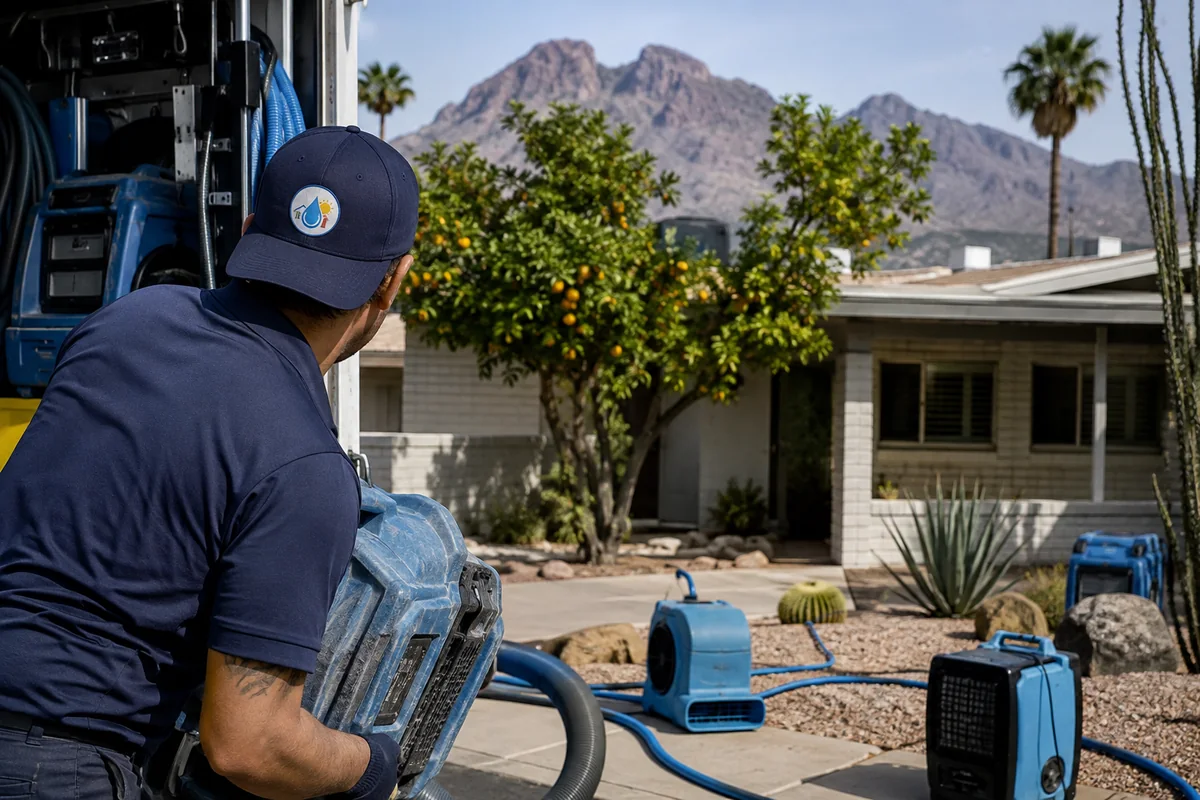
Water Damage Tempe is a water damage restoration company providing water extraction, structural drying, and mold remediation in Phoenix, AZ — live phone answer, 24/7.
IICRC S500 standard followed
Moisture readings logged until dry
Written scope before work starts
24/7 emergency response
Insurance-ready documentation
Sound familiar?
The four reasons people in Phoenix call about water damage
A pipe just burst
Water is actively spreading in your Phoenix property, and mold can begin colonizing damaged material within 24-48 hours — speed matters more than almost anything else here.
A slow, mysterious wet patch
A warm spot on tile or a damp patch of carpet with no obvious source is a classic sign of a slab leak that’s been running for a while — common across this market’s slab-on-grade construction.
Monsoon storm flooding in Phoenix
Flat and low-slope roofs common on Phoenix-area homes pond water when monsoon debris clogs the drains, finding weak points in aging roof coatings and flashing.
Sewage backup
A biohazard situation that needs professional handling, not a DIY cleanup — Category 3 water carries real health risk.
Most requested in Phoenix
What we do in Phoenix
Water Extraction
Water extraction in Tempe, AZ removes standing water fast, mapped with moisture readings before mold sets in — a written scope before any work starts.
Details →Structural Drying
Structural drying in Tempe, AZ pulls trapped moisture from framing and drywall, tracked by daily psychrometric readings until the structure is truly dry.
Details →Mold Remediation
Mold remediation in Tempe, AZ contains and removes mold that starts colonizing wet material within 24-48 hours, with HEPA air scrubbing and a clearance check.
Details →Commercial Water Damage Restoration
Commercial water damage restoration in Tempe, AZ is scoped around minimizing business downtime near Mill Avenue and the ASU corridor with phased, after-hours work.
Details →How it works
How we handle a Phoenix loss
Call — day or night
Tell us what happened. A real person answers, 24/7, and we book a free on-site assessment.
We assess the damage
We identify the water category, check how far it has migrated into flooring, subfloor, and walls, and take moisture readings to establish a baseline.
Extraction and drying
Water extracted, affected materials addressed, and structural drying equipment set and monitored until the readings confirm the property is dry.
Documentation and walkthrough
Time-stamped photos and moisture logs handed over, useful for an insurance claim, and we walk the finished job with you before we leave.
Water damage in Phoenix: what's actually different here
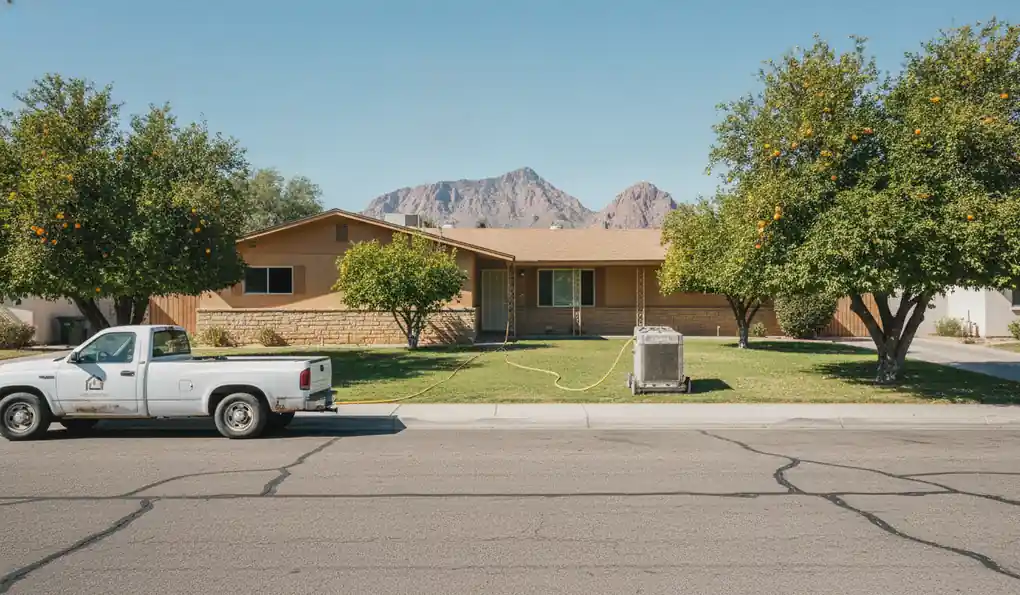
Water Damage Tempe serves Phoenix through the Arcadia corridor — the neighborhood directly across the Arizona Canal and Papago Park from our Tempe base, bounded roughly by 44th Street, Camelback Road, Scottsdale Road, and the canal itself. The same frost-free slab-on-grade construction, hard-water copper corrosion, and monsoon flat-roof ponding that drive water damage across the rest of this service area apply here too, but Arcadia's own history adds a mechanism none of our other cities share at this scale: flood irrigation. Laid out starting in 1919 as a citrus-orchard subdivision, Arcadia still carries functioning irrigation infrastructure from the original Arcadia Water Company — many lots still hold flood-irrigation rights, and the Salt River Valley Water Users Association delivers water to those lots roughly every 14 days in summer and every 28 days in winter, intentionally flooding the yard 2-3 inches deep to keep the neighborhood's citrus trees and grass green.
That's a real, engineered water-intrusion vector most of Phoenix doesn't have to think about: a flood-irrigated yard sitting a few inches deep in water on a delivery day puts real pressure on grading, foundation drainage, and any low point where a slab meets the yard, and it means an Arcadia water-damage call sometimes traces back to landscaping and irrigation timing rather than a plumbing failure inside the house. Layered on top of that, most of Arcadia's housing dates to the mid-1950s onward, when the citrus groves were subdivided into ranch-home lots — decades-old under-slab copper on large, mature lots, the same slab-leak risk profile found in Tempe's and Mesa's oldest neighborhoods, but sitting under some of the highest property values in the Phoenix metro, where a teardown-rebuild or a full remodel is common enough that water damage often meets a property mid-renovation rather than in its original condition.
Camelback Mountain rises directly over Arcadia's north edge, and monsoon storms send real runoff down its washes into the streets and yards below — a distinct source of water intrusion from the flat-roof ponding that drives most of the rest of the metro's storm damage, and one more reason a flood-irrigated, canal-adjacent property here needs someone who knows the difference between irrigation water, storm runoff, and a plumbing failure before starting extraction. Arcadia sits close enough to our Tempe base, across Papago Park and the Loop 202 corridor, that dispatch time here matches the rest of our primary service area.
Why us
Built around this desert market's real water-damage risks, not a generic flood-cleanup script
We know Phoenix-metro homes rarely have basements
Water damage here shows up as slab leaks, water heater failures, AC and evaporative-cooler leaks, and monsoon roof intrusion — not a flooded basement. We scope the job around where the water actually is, not where a national script assumes it is.
Why Arizona homes don’t have basements →We check for a slab leak before we treat the surface
Arizona's hard water and expansive clay soil make slab leaks a common, often-hidden cause of water damage under flooring and walls. We look for the source, not just the visible wet patch.
Caliche soil and slab leaks →Written scope, not a phone-call-only number
You get a scope and price before work starts, with the water category and affected areas broken out as their own lines. No day-of surprises.
We work with landlords and property managers, not just single-family homeowners
Tempe's ASU-driven rental market means water damage often involves a landlord, a property manager, or a shared plumbing stack — we coordinate with whoever needs to be looped in.
Landlord & property manager guide →
Neighborhoods
Areas of Phoenix we work in
- Arcadia
- Arcadia Lite
- Mountgrove
- Camelback Corridor (bordering Arcadia's west edge)
- Papago Park area (Arcadia's southern edge toward Tempe)
Around town
Landmarks we work near
- Camelback Mountain
- La Grande Orange Grocery & Pizzeria
- Arcadia High School
- Royal Palms Resort and Spa
- Arizona Country Club
Local economy
Royal Palms Resort and Spa · Arizona Country Club
How we reach you
Getting to Phoenix
- 44th Street — Arcadia's main north-south spine
- Camelback Road
- Indian School Road
- Loop 202 (Red Mountain Freeway) — connects Arcadia's southern edge toward Tempe
Transit: No Valley Metro light rail line reaches Arcadia; the nearest stations run along Washington/Van Buren through downtown Phoenix, several miles south, so Arcadia residents and businesses rely on car and bus routes.
Service area
Phoenix, AZ on the map
Phoenix, AZ · Maricopa County
Population 1,650,000 · 1,086 ft elevation
Directly borders Tempe to the west.
View Phoenix on the map →Questions
Water damage questions from Phoenix
How much does water damage restoration cost in Phoenix, AZ?
Phoenix sits inside the same Maricopa County water damage pricing as the rest of the metro — a 2025 average of $2,290-$2,418, with the broader range across sources running $1,200-$7,600. Mold remediation has a Phoenix-specific figure: Angi puts the average at $1,836, with a $927-$2,745 range depending on the extent of the job. A free on-site assessment gets you a number specific to your property.
What is flood irrigation, and does it affect water damage risk in Arcadia?
Flood irrigation is a real, still-functioning system in Arcadia dating back to the neighborhood's citrus-farming origins: many lots hold irrigation rights, and the Salt River Valley Water Users Association delivers canal water roughly every 14 days in summer and every 28 days in winter, flooding the yard 2-3 inches deep on purpose. It's a genuine local water-intrusion factor — grading, drainage, and low points where a slab meets the yard all matter more on an irrigated lot than on a standard desert-landscaped property.
Do you serve all of Phoenix, or just this area?
Our Phoenix coverage is centered on the Arcadia corridor — roughly 44th Street to Scottsdale Road, Camelback Road to the Arizona Canal — the part of Phoenix closest to our Tempe base. Call regardless of where in the Phoenix metro you're located; if you're outside that corridor we'll tell you honestly whether we can reach you quickly.
Are Arcadia's older ranch homes at more risk of a slab leak?
Yes, for the same reason older homes carry more slab-leak risk everywhere in this market: most of Arcadia's housing dates to the mid-1950s onward, meaning decades-old copper supply lines have had more time to corrode under Phoenix's hard water. It's the same mechanism driving slab leaks in Tempe's and Mesa's oldest neighborhoods, just under some of the metro's highest property values.
How fast can you get to a water damage call in the Arcadia area?
A real person answers the phone 24/7, and we book a free on-site assessment as soon as you call. Arcadia sits across Papago Park and the Loop 202 corridor from our Tempe base, so dispatch time here matches the rest of our primary service area.
Nearby
We also serve these areas
Free water damage assessment in Phoenix
Live phone answer, 24/7. We assess the damage, identify the water category, and hand you a written scope.