
Learn
How Should Landlords and Property Managers Handle Water Damage in Tempe?
Tempe is roughly 58% renter-occupied, driven by ASU — one of the highest renter concentrations in the Phoenix metro. Here's what that means for landlords and property managers handling water damage.
Tempe is roughly 58% renter-occupied, driven largely by ASU, which means shared-wall and shared-plumbing-stack failures affecting multiple units, tenant notification obligations, and renter-vs-landlord insurance responsibility come up constantly here. Fast, documented response protects both the property and the landlord-tenant relationship — and often determines who ultimately bears the cost.
Published 2026-08-15 · Updated 2026-08-30
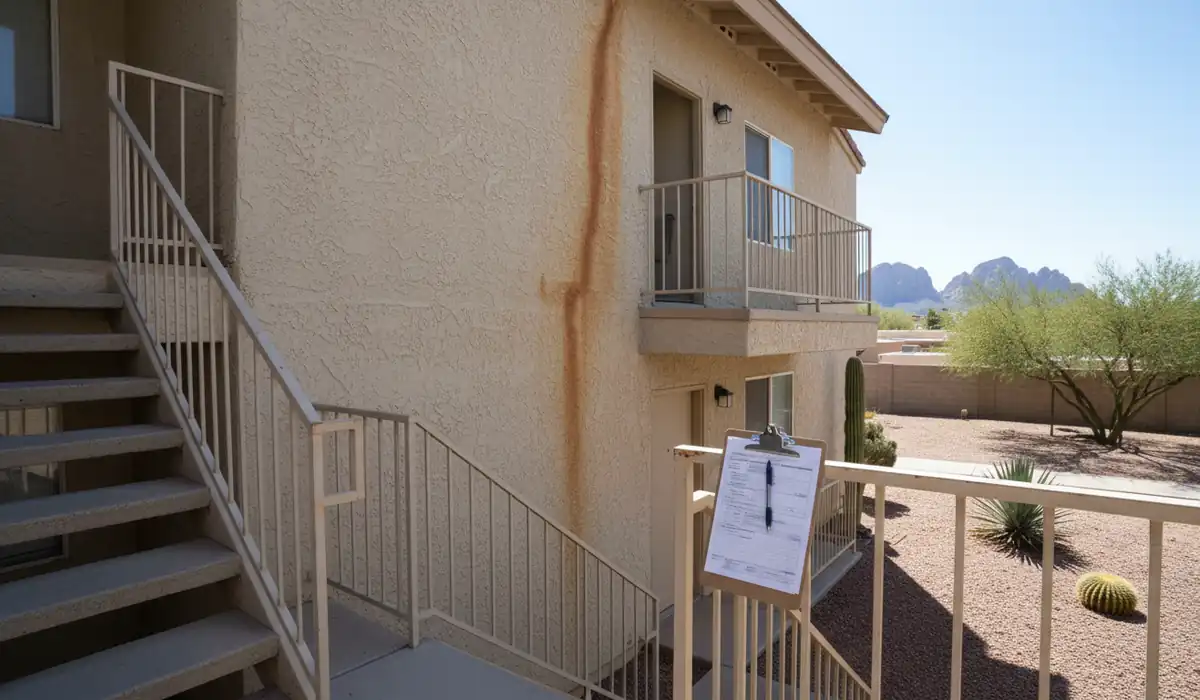
Water Damage Tempe is a water damage restoration company serving Tempe, AZ and the Phoenix metro, and a meaningful share of our calls come from landlords and property managers, not owner-occupants — a direct reflection of who actually lives in this city.
Tempe’s renter-occupancy rate is genuinely unusual
Two independently-checked sources both put Tempe’s renter-occupancy rate in the 57.7%-58.4% range — one of the highest renter concentrations in the Phoenix metro, driven directly by Arizona State University’s main campus, one of the largest public universities in the country by enrollment, with thousands of direct employees and tens of thousands of students needing housing near campus. That’s not a marginal statistic; it means the majority of Tempe’s housing stock is rental property, and it means water damage response here has to account for a customer base — landlords, property managers, and tenants — that a purely single-family-homeowner-framed approach simply misses.
Why this changes what a water damage response actually needs to handle
Shared-wall and shared-plumbing-stack failures. In multi-family buildings — apartments, condos, duplexes — a single plumbing failure can affect more than one unit at once, since supply lines and drain stacks are often shared or run adjacent to neighboring units. A water heater failure or slab leak in one unit can show up as a ceiling stain in the unit below, meaning a proper response has to assess and document more than just the unit where the problem originated.
Notification and access logistics. Getting a crew into a rented unit means coordinating with a tenant, a property manager, or both — schedules, access codes, and notice requirements all factor in, in a way that doesn’t come up on an owner-occupied single-family call. A property manager handling multiple properties needs a restoration company that can move fast on scheduling, not one that adds its own delay to an already time-sensitive situation.
Renter-vs-landlord insurance responsibility. This is the single most common point of confusion on rental water damage calls. A landlord’s property insurance generally covers the building structure and the landlord’s own fixtures and appliances; it typically does not cover a tenant’s personal belongings. That’s what renters insurance is for, and in a market where a majority of residents rent, that coverage gap matters at real scale — see our renters insurance guide for the specifics.
What documentation looks like on a rental job
Because responsibility questions come up more often on rental properties than owner-occupied ones, documentation matters even more here. That means time-stamped photos of the damage as found, a written scope separating what’s structural (typically the landlord’s responsibility) from what’s contents (typically the tenant’s), and clear notes on the apparent cause — a sudden plumbing failure reads very differently, both for insurance and for landlord-tenant liability, than damage from a slow, unreported leak.
The connection to Tempe’s building stock
A lot of Tempe’s rental housing, like the broader ownership-occupied market, sits on the same slab-on-grade foundation and shares the same regional risk factors covered in our no-basements guide and slab leak guide — slab leaks, water heater failures, monsoon roof intrusion. Multi-unit buildings add the shared-wall complication on top of those same underlying causes, which is why a rental-property call often means assessing more square footage and more affected parties than the equivalent single-family call.
What property managers can do proactively
A few practical habits reduce both the frequency and severity of water damage claims across a rental portfolio: requiring renters insurance as a lease condition (protects tenant belongings and clarifies the responsibility line up front), responding to any tenant-reported leak or dampness immediately rather than batching it into routine maintenance, and keeping a relationship with a restoration company that can respond the same day rather than starting the vendor search after the water’s already spread to a second unit.
The bottom line
Water damage in a rental property carries the same urgency as anywhere else, plus a layer of coordination and documentation that owner-occupied jobs don’t need. Call (480) 531-6541 for a free on-site assessment — we work directly with property managers and can move fast on scheduling and access.
Related reading
The bottom line
If you want this priced for your own property rather than in ranges, we come out and assess at no charge across Tempe and the Phoenix metro — including Mesa, Chandler, Scottsdale, Gilbert, and Phoenix. You get a written scope with the water category and affected areas broken out separately. Call (480) 531-6541.