
Learn
Does Renters Insurance Cover Water Damage in an ASU-Area Rental?
What renters insurance actually covers in a Tempe rental, what the landlord's policy covers instead, and why this gap matters in a city that's roughly 58% renter-occupied.
Renters insurance covers a tenant's own belongings damaged by a covered water event — not the building itself, which is the landlord's responsibility. In a city where roughly 58% of residents rent, that split causes real confusion: a landlord's policy pays to fix the unit, but a tenant without their own policy has no coverage for their furniture, electronics, or textbooks.
Published 2026-08-20 · Updated 2026-09-01
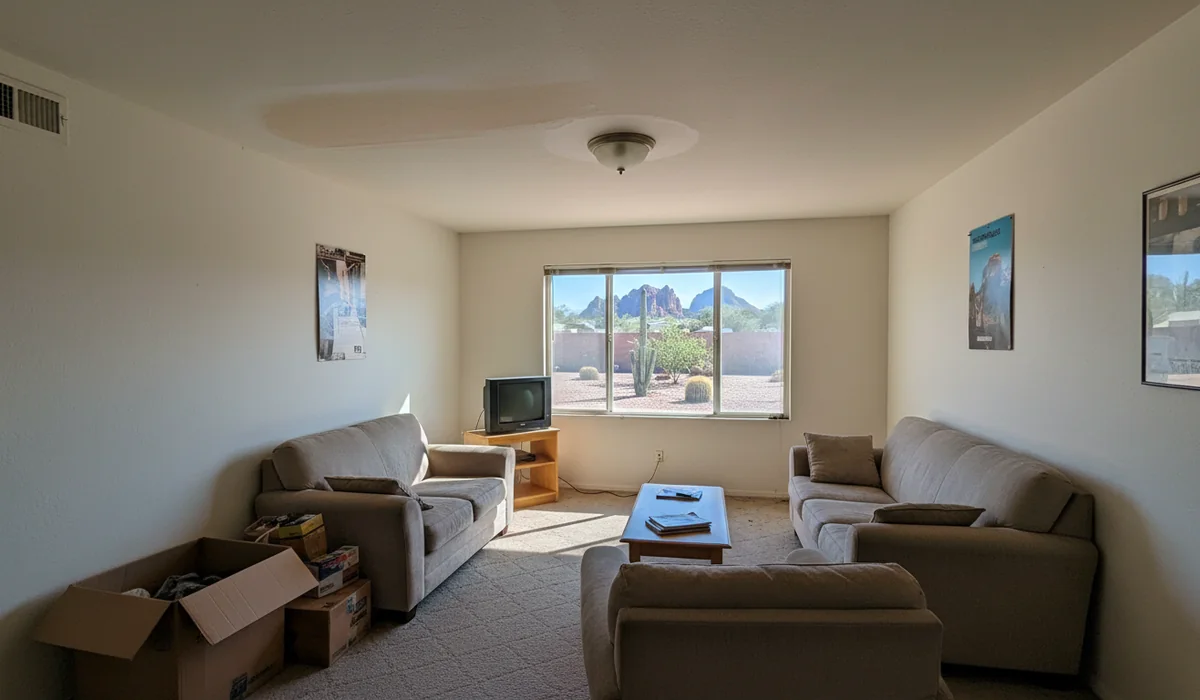
Water Damage Tempe is a water damage restoration company serving Tempe, AZ and the Phoenix metro, and renters insurance confusion comes up constantly in a city built around one of the largest public universities in the country.
What renters insurance actually covers
A renters insurance policy covers the tenant’s own personal property — furniture, electronics, clothing, textbooks, anything owned by the person living in the unit — when it’s damaged by a covered event, generally following the same sudden-vs-gradual logic that applies to homeowners coverage. It does not cover the building, the walls, the flooring, or any fixture that belongs to the property itself.
What the landlord’s policy covers instead
The landlord’s or property owner’s insurance policy covers the structure: the unit itself, shared building systems, and common areas. That policy has no obligation to a tenant’s personal belongings — a landlord’s insurer pays to repair the drywall and flooring a water event damaged, not to replace a tenant’s couch or laptop that got soaked in the same event. These are two entirely separate policies covering two entirely separate categories of loss, and neither one substitutes for the other.
Why Tempe’s renter-heavy population makes this gap matter
Tempe is roughly 57.7%-58.4% renter-occupied, independently confirmed across sources — one of the highest renter concentrations in the Phoenix metro, driven directly by Arizona State University’s main campus. That means a meaningfully larger share of this city’s water damage calls involve a tenant whose personal property is at risk with no coverage at all, if they’ve assumed — incorrectly — that the building being insured means their own belongings are too. National restoration content written for a mostly-homeowner audience rarely addresses this gap, even though it applies to a majority of Tempe’s residents.
Shared-wall and shared-plumbing failures in multi-unit buildings
A meaningful share of rental water damage in Tempe isn’t a single-unit event — it’s a shared plumbing stack or shared wall failure affecting multiple units from one source. In that scenario, the building-side repair is still the landlord’s or property manager’s responsibility across every affected unit, while each individual tenant’s renters policy (or lack of one) determines what happens to their own belongings independently, unit by unit.
ASU-area rentals specifically
Off-campus student housing near ASU adds its own wrinkle: many of these units are older multi-unit buildings converted or built specifically for high-turnover student tenancy, often with several unrelated roommates on one lease and shared plumbing systems original to a decades-old building. A single failure in that kind of building can affect multiple bedrooms or multiple units at once, and with several tenants who may not have individually verified whether a lease requires renters insurance, it’s common for some residents in the same affected unit to have coverage for their belongings while others don’t — worth confirming directly with roommates rather than assuming.
What a renter should do the moment water shows up
Notify the landlord or property manager immediately — the structural response is their responsibility and their timeline to act on. Photograph the damage and the source before anything is moved, the same documentation standard that applies to any water damage claim. And if a renters policy exists, call it in parallel rather than waiting to see how the structural side resolves first, since the two claims are independent and one doesn’t need to finish before the other starts.
Related questions
The bottom line
If you want this priced for your own property rather than in ranges, we come out and assess at no charge across Tempe and the Phoenix metro — including Mesa, Chandler, Scottsdale, Gilbert, and Phoenix. You get a written scope with the water category and affected areas broken out separately. Call (480) 531-6541.