
Learn
How Should Tempe Homeowners Prepare for Monsoon Season Water Damage?
Tempe's monsoon season runs June 15-September 30. Here's how flat-roof ponding, flash flooding, and canal-fed irrigation actually cause water damage here, and how to prepare.
Monsoon season runs officially June 15-September 30 in Arizona. The main risks are flat and low-slope roofs ponding water that finds weak spots in aging coatings, flash flooding in known low-lying areas, and irrigation-canal overflow. Clearing roof drains before the season starts and knowing your home's flood-risk profile are the two most effective preparation steps.
Published 2026-08-15 · Updated 2026-08-30
Water Damage Tempe is a water damage restoration company serving Tempe, AZ and the Phoenix metro, and monsoon season is the one time of year even homeowners who’ve never had a water problem before start paying attention — this guide covers what actually drives storm-related water damage here and how to get ahead of it.
When monsoon season actually runs
Arizona’s monsoon season has an official designation from the National Weather Service (in place since 2008): June 15 through September 30. That’s a wider window than the general public conversation about “monsoon storms” sometimes implies, and it’s worth marking on a calendar as the period to have roof drains and gutters checked before, not during.
The flat-roof mechanism, explained
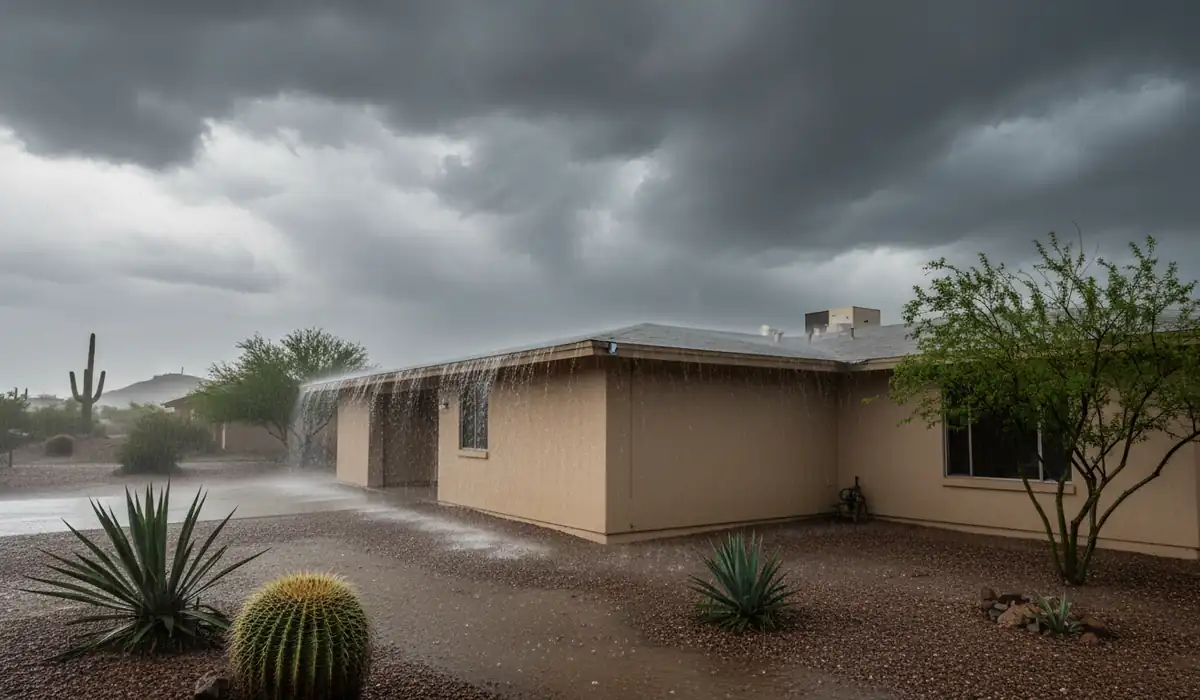
This is the single most locally-specific storm risk, and it’s a mechanism national restoration-company content almost never explains. Phoenix-area homes commonly use flat or low-slope roof designs, a natural fit for this climate’s lack of snow load and a distinct building style from the pitched, shingled roofs standard in most of the country. A pitched roof sheds rainwater immediately by design; a flat roof instead relies on drains and slight grading to move water off the surface over time. Monsoon storms deposit significant dust and debris — sometimes ahead of a full haboob dust storm — that clogs those drains mid-storm, right when rainfall intensity is highest. The result is ponding water sitting on the roof surface for longer than it should, which finds any weak point in aging roof coatings, flashing, or seams far more readily than water that’s draining away as it falls. This is a genuinely distinct mechanism from pitched-roof shingle failure, and it’s the reason roof-related water damage here often traces back to a clogged drain rather than storm-damaged shingles.
Flash flooding: a bigger risk than the desert reputation suggests
Tempe’s flood-risk profile runs counter to the “dry desert city” assumption most people carry in. One flood-risk modeling source estimates roughly 99% of Tempe buildings carry some flood risk, with an average ~19% chance of 2.3+ feet of flood depth over a 30-year window. This isn’t abstract: isolated monsoon flash flooding has recently affected areas near US-60/McClintock Dr and the Loop 101/Southern Ave interchange (September 2025). Tempe’s generally flat terrain — apart from Tempe Butte and Papago Park — means water doesn’t drain away by gravity the way it would in hillier terrain; it pools, and monsoon storms can deliver an intense volume of rain in a short window that urban drainage doesn’t always keep pace with.
The canal-irrigation angle almost nobody mentions
A genuinely regional water-intrusion vector: Salt River Project’s canal network, including the Tempe Canal — the oldest continuously-used canal in SRP’s entire system — still delivers real flood/lateral irrigation to residential yards in parts of the East Valley. This is a working agricultural-style irrigation system still in active use, and overflow or mistiming from it is a locally-specific water-intrusion vector that national restoration-company copy simply never mentions, because it doesn’t exist as a concept in most other markets. If you’re on flood irrigation, SRP maintains a 24-hour hotline for reporting an overflow issue — worth having saved before you need it, not during.
Practical pre-season preparation
Clear roof drains and scuppers before June 15. This is the single highest-leverage step for a flat-roof home — a clear drain path is the difference between a storm draining off normally and a storm ponding water against your roof coating for hours.
Know your home’s specific flood-risk profile, not just the citywide average — proximity to a wash, a low point in your neighborhood’s grading, or history of street flooding nearby are all more relevant than a general city statistic.
Have your slab-leak and general plumbing risk addressed separately — monsoon prep and slab-leak prevention are different problems, but a home already carrying hidden slab moisture (see our signs of a slab leak guide) has less margin for a storm event on top of it.
Save the SRP flood-irrigation hotline number if you’re in an irrigated area, and know where your property’s irrigation gate is.
What to do once water’s already intruded
If a storm has already gotten water into the house — through a roof leak, a flooded entry point, or irrigation overflow — the same urgency applies as any other water intrusion: the 24-48 hour mold-colonization window doesn’t pause for a storm event, and knowing your water damage category matters just as much when the source is a monsoon storm as when it’s a burst pipe.
The bottom line
Monsoon water damage here has real, specific mechanisms — clogged flat-roof drains, flash flooding on flat terrain, and even active irrigation infrastructure — that a generic “storm damage” warning doesn’t cover. Call (480) 531-6541 for a free on-site assessment, before or after the storm hits.
Related reading
The bottom line
If you want this priced for your own property rather than in ranges, we come out and assess at no charge across Tempe and the Phoenix metro — including Mesa, Chandler, Scottsdale, Gilbert, and Phoenix. You get a written scope with the water category and affected areas broken out separately. Call (480) 531-6541.